




Totally different for several obvious reasons, archery and rifle hunters basically have opposite goals when it comes to techniques and setting up for elk. Elk calling can be very effective during the rifle season, especially in October, but as you will read time and again in the content to come, our goal for a bowhunter is to find a “tight” setup. How to use terrain and thick cover, that keeps a bowhunter from seeing the elk that is a long way off, forcing a bull to come within a bowhunter’s shooting range in order to see the “other elk” that is making the calls.
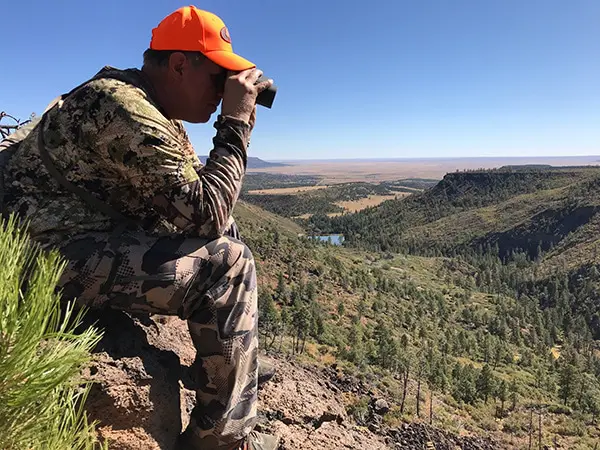
We want just the opposite for the rifle hunter. The more open the terrain or timber, the better. Where we never want a bowhunter to set up on the highpoint edge of a park calling a bull replying on the other side, that is EXACTLY what we would want a rifle hunter to do. When a bull is called out into a park from the other side, he will show himself and stop, wanting the other bull or cow to show themselves. A horrible situation for a bowhunter. A prime-time situation for a rifle hunter.
A bowhunter hunts and works to get a shot within the heavy timber where optics are not really needed. The thicker the better. A rifle hunter hunts with optics, which are critical to the hunt, from high points and makes plays on a targeted bull to have a shot in the open. The more open the better. Again, two different weapons and in many ways two different mentalities.
With that said, we will separate the two and detail each for the training. However I highly recommend for you to go through each of the content areas. There is something to learn from each of the goals and thought processes and when it comes to hunting skill sets, the more you know… your capabilities and thought processing in unique situations grow as well. We always want you to be THAT elk hunter.
(Sit. 2 – Solo with Bull Coming)
There are two ways you know the bull is moving to you. The first will be if he is sounding off on his own and that far away bugle is now way closer. Or you have stopped because you have not heard the bull for a while, so you use the call that he responded to in the first place to try to get him to give up his position, and his response is definitely moving in from his original position.
If you determine the bull is moving to you, then you are:
- Checking the wind in relation to the direction of the bull
- If the bull responded to a call you made, immediately move ahead about 40 yards or where you see the best location for your set-up. Don’t worry about noise.
If he is sounding off on his own, you don’t need to move forward. He has not been able to pinpoint you since you haven’t had to call.
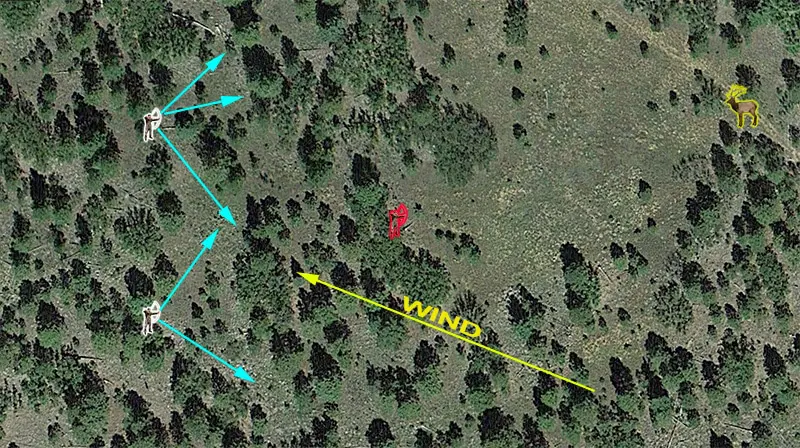
**IMPORTANT NOTE – If you find yourself on the edge of a large clearing or park as we call them, DO NOT set up on the edge of the park. If you do, the bull will clear the trees on the other side and expect you to show yourself. You will end up with a ‘Hung Bull” for sure. In this case, you need to get back into the trees and call away from the bull in order to pull him across that clearing and get him into a tight setup where he has to search you out to see the elk he is coming in to see.
- Looking for a setup location that:
- Sets the wind either in your face or with a cross wind that gives you a shooting lane before the bull can scent you.
- The set up is as tight as possible, with thick cover or using terrain to force the bull to get close within your killing shot range in order to see you.
- Breaks up your silhouette. Always check for limbs that could mess with your draw and clear debris around your feet or knees.
- Once you find that location:
- Once the bull is sighted, if he is coming in, just stay silent. If he needs to be turned or pulled, make sure your calls are aimed behind you to seem further back than you are.
(Sit. 2 – Partners with Bull Coming)
I believe that this scenario with a partner is one of the deadliest combinations there is. The bull has given up his position. You have a line on him and you are able to have the shooter on that line, just to the downwind side, and pull that bull right by your shooter. Additionally, the bulls attention is on the caller’s location which is a prime situation. You throw a decoy into the mix and you can really get the bulls attention totally occupied. This is so much fun to watch unfold!
If you determine the bull is moving to you, then you are:
- Checking the wind in relation to the direction of the bull
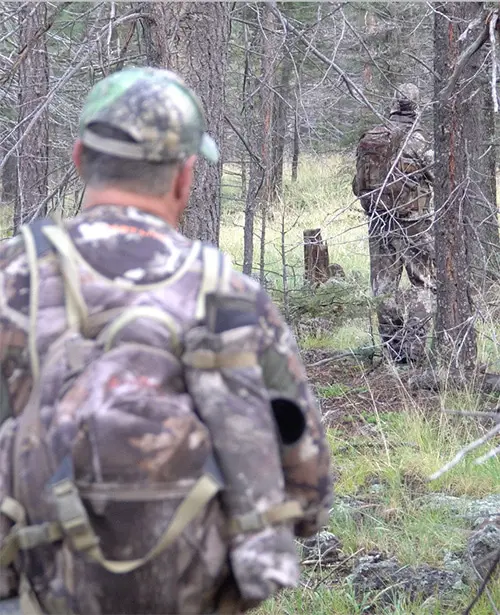
- If the bull responded to a call you made, have your shooter move ahead about 30 to 40 yards and 15 to 20 yards to the downwind side, like an upside down “L”. That distance will be controlled by where they see the best location for their set-up. Don’t worry about noise. When in position, clear the area of anything that could keep you from moving or drawing without debris or branches making noise. Don’t worry about making noise to do this. Harder to pinpoint those types of noises and they add to the situation.
Just like in the solo scenario, if he is sounding off on his own, you don’t need to move forward. Find the best setup and the caller will move back behind the shooter, 40 yards or more. As the caller, if possible, I want to get back far enough where I can see my shooter but still somewhat have the ability to move if need be. A change in terrain is perfect for this and allows me to move to steer a bull and pull him by my shooter. If I am not in a place conducive to being able to move, than I want to be able to see my shooter and I will just aim my calls to steer the bull. - Looking for a setup location that:
- Sets the wind either in your face or with a cross wind that gives you a shooting lane before the bull can scent you.
- You want a tight setup if possible, but this is not as critical for the shooter in a partner set. It is more critical for the caller to be where the bull has to come move forward in order to see the other bull.
- Breaks up your silhouette. Always check for limbs that could mess with your draw and clear debris around your feet or knees.
- As the Shooter:
- Once the bull is sighted, if he is coming in, just stay silent. If he needs to be turned or pulled, that is the job of the caller. Often the caller will not be able to see the bull, but will be able to see you. The caller will be watching your body language in order to tell if you see a bull. It can help as well to have a subtle hand signal to let the caller know that the bull is in sight and coming.
(Sit. 3 –Solo.. Oh CRAP!)
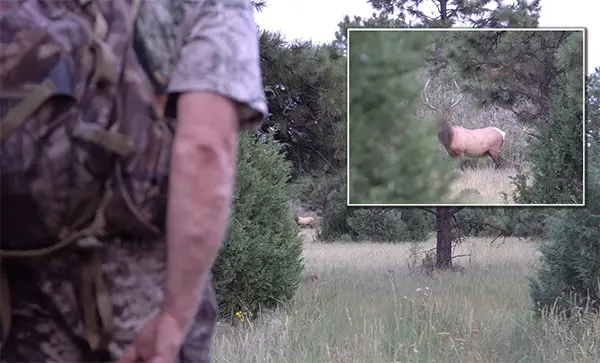
Trust me, this scenario is going to happen way more times than you can imaging. Cause when you least expect it…well, that is elk hunting! You will be closing in on a bull and something inside tells you to stop, I believe it’s that sixth sense we all have. You listen and listen and nothing. So you let out a small cow call hoping for a response and all of a sudden the woods ERUPT with a bugle the SOUNDS LIKE HE IS ON TOP OF YOU! Now your brain is racing and you have either dropped down to the ground or your feet are doing things that you never told them to do! Kinda like one of those road runner movies were everything is moving but your not going anywhere! (I know you are laughing just with the vision in your head!).
Not the optimum situation, but really y’all, it’s these heart thumping moments that we all live for. And if you just keep your wits about you you can definitely close the deal. Clear your head and do the following:
- Forget the wind, it is what it is. the only thing you may want to note is at what point the elk may cross you scent line so you can make a play before he does.
- Your MOST IMPORTANT action right now is to give yourself the best opportunity at a shot and that means SHOOTING LANES. Move RIGHT NOW to the best spot to give yourself shooting lanes.
- Once there, find any kind of backdrop. If there is not one, drop down to your knees and get ready. A lower object will pass longer than a standing one.
- Be ready to stop the bull with a bugle or cow call once he is in your lane.
- Boom! Make it happen!
(Sit. 3 – Partners… Oh CRAP!)
In this situation you can forget about moving away from the shooter. You are now one. Treat it just like the Solo situation in that you HAVE TO MOVE to get the best shooting lanes and situation possible.
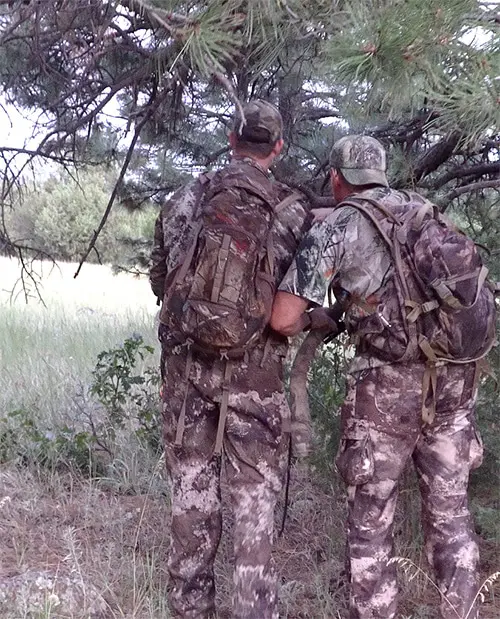
The caller will most likely be right off of the shooters back and use the shooter’s body as a screen if you need to throw any kind of calls. Since the caller is right on the shooter’s shoulder, he/she should already be clicking off yardages for the shooter and giving landmarks and yardages where the bull would be for the shot. The shooter MUST BE READY to shoot, nothing else. The caller’s job will be to stop the bull in the shooting lane and cover the shooters draw if they have not already drawn.
Here is a recap:
- Forget the wind…it is what it is.
- MOVE to get the best shooting lanes and situation possible
- Become one in the setup. The caller will use the shooter’s body as a screen.
- Shooter MUST stay ready to shoot. Let the caller click off yardages for the shooter.
- The caller’s job will be to stop the bull in the shooting lane and cover the shooter’s draw if they have not already drawn.
- Boom! Tag Team!
FOUR THINGS ABOUT STATIC SET-UPS
THEY ARE NOT RANDOM –
There is a reason that you decided to work a set-up in that location. Whether you; smell elk, have come across steaming droppings with tracks, you visually see a target bull in the distance, you shadowed a bull and his cows to their bed, you found a wallow all muddied up, you hear a bull across a fence in another hunt unit your not licensed for. All perfect reasons for a static scenario session! I will expand on these more below.
THEY TAKE TIME –
The biggest mistake elk hunters make is that they will leave a set-up too soon. Trust me, I totally get it. The patience it takes is often beyond me. It seems like you are wasting time. Twenty to 30 minutes have gone by and nothing! But understand that SO MANY times, hunters get up to leave a static set-up only to scare off a bull that was coming in to the set! It happens ALL THE TIME.
But I want you to think about it this way…it’s only a waste of time if you bail on a scenario before it can be effective. Elk don’t move in our time when it comes to covering distance. They move in theirs. You have to be prepared to give a scenario 45 minutes to an hour minimum. If you are doing a mid-day set-up, then don’t sweat it it. You are actually utilizing time that most hunters spend back in camp. Heck, if you get tired, take a nap and get after it again when you wake up. You might be surprised to see what walks in on you as soon as you start to drift off!
 THEY WILL HAVE ELK COME IN SILENTLY –
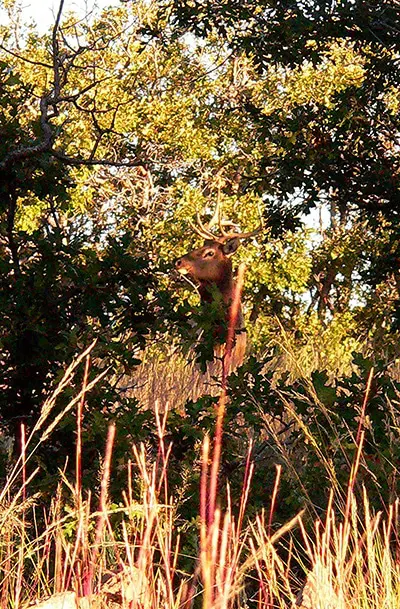
This is the number one reason that guys end up losing their patience only to stand up and turn to leave and find themselves, face to face, 20 yards from a bull! There are a lot of variables as to why a bull comes in silent; time of year, the mode the bull is currently in, whether he has been called in before, if he just got his butt whipped the night before… you just don’t know. But most likely it will be a satellite and he just wants to see what he’s getting into. You have to be listening for responses other than a bugle. Listen for rocks turning, branches breaking or footfalls. Be looking and EXPECTING a bull to come in silent. If it is a partner set-up, make sure you are checking different viewpoints.
Elk coming in silently is not always the case. Many times your scenario may get a bull worked up and responding vocally. This is the one time that I tell you to stay put and NOT TO CUT THE DISTANCE until the situation demands otherwise. You currently have all the advantages. He is coming to you. You have selected the best tight set-up situation. He will have to show himself in your effective range in order to see you. He is moving, you are not. So again, all current advantages in your favor. As soon as you decide to move in on him, you lose all of those advantages. So there has to be a very good reason before you do. For example, if the wind situation is not right or you need to move just a little to find better shooting lanes from the direction he is approaching. Otherwise, trust in the scenario and your set-up and stay put.
THEY ARE LIKE A BOX OF CHOCOLATES –
That’s exactly right. When using static set-ups, “You never know what your gonna get”. With these kind of calling set-ups, you are not really targeting a particular type of elk because you have not engaged with one. If I go screaming challenge bugles all over the mountain, I know that when I get a scream back at me, I have a bull on the line. But in “Static” set-ups, I can have cows, raghorns, spikes or mature bulls come into the set. That can change if I get a bull worked up during a particular scenario and then start playing to that situation. But many times, you are going to have elk come in silently for various reasons. If you do have cows that come in, be ready! Most likely there is a bull bringing up the rear.
POSSIBLE “STATIC” SET-UP SITUATIONS
 SMELLING ELK –
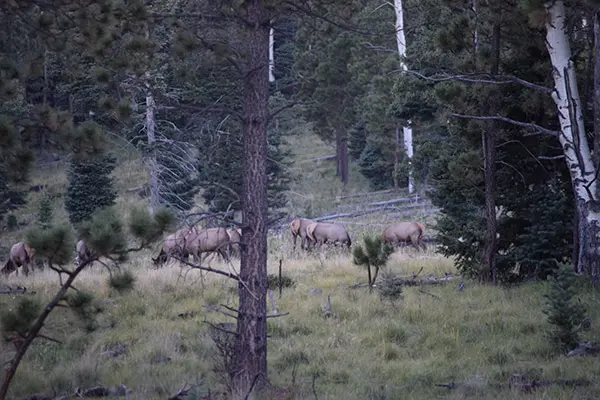
The very first skill-set that I ever used to hunt elk was using my nose. Elk have a VERY distinct smell. In the early season, I like to describe it as a licorice type of smell and their urine is pretty close to that of Moo Cows (bovine) but a tad bit sweeter smelling. Personally, I like the smell but my wife thinks I’m a bit warped, lol. Later as the bulls start rutting and getting worked up, they urinate in the dirt or in wallows and roll in it. Just adding to their musky smell. Again, the overall smell is very close to cattle.
If you smell elk, you are either catching a smell of the actual animal or their urine in the area. Move into the scent with the wind in your face. If you go twenty yards or so and the scent is no longer prevalent, you most likely had urine in the area. If you are still smelling elk after 20 yards or so, stop. You are VERY close. Depending on the place and time of day, this could be a great place to find a setup and start calling.
I say depending on the place and time of day for a couple of reasons. If it is early and you are in the bottoms, you may be smelling a group that is moving to their beds. That would be a tough call-in. They are most likely heading to a destination. In that case, I would continue to follow scent until I was either able to hear some elk talk or get a visual. But if it is mid-day and you are high in the thick timber, you most likely have a herd or an elk or two nearby. Great situation for a static set-up. You have to make sure to read the situation.
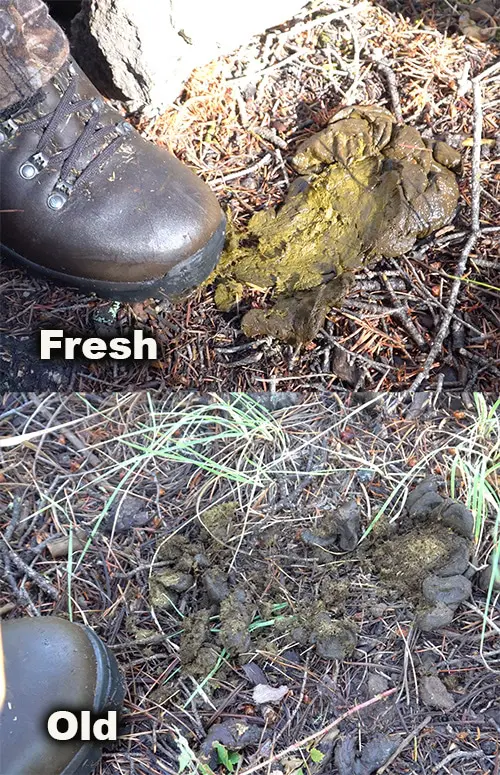 FRESH SIGN –
If you are finding fresh tracks along with wet green droppings, you have elk nearby. If those droppings are steaming on an early cold morning, get set up and start calling! This will most likely happen at first light when it is still very cool and the elk have not started to move to bed yet.
Elk droppings, when fresh, are a moist lighter green color. When smashed with your foot, it will spread a lot like the consistency of oil or acrylic paint right out of the tube. The wetter the season, the wetter the droppings and the more they stay together as a pile. The drier the year, the droppings will have more shape to them and may drop as individual pieces, much like deer droppings. As the droppings are exposed to air, they will turn a darker green on the outside. The harder and more dried the droppings are, the older. You will see a lot of droppings that look large, hard, dried and cracked. Those are very old from the prior year. They will be in an area that has been used consistently by the elk in the past and something that I always mark mentally or on my GPS. Information for the future.
YOU CAN SEE THEM –
This can happen if you spot a herd or a group of elk that are not in an area where you can stalk or get an approach without being seen. Most of the time that means that they are in a clearing of some sort. The worse thing you could do in this situation is to get on the edge of the clearing and start calling. You have just been pinpointed and the elk are going to expect you to show yourself. They are not going to come to you.
The correct approach would be to get back into the timber, 60 to 100 yards, and locate a tight set-up if possible to begin your chosen scenario. If by yourself, you need to throw the calls behind you. If with a partner, I would have the partner stay close to the edge of the clearing between the caller and the elk. That is a super situation. Not only would he have a chance at the elk coming to your calls, but he has eyes on the situation and can get back to you if things don’t work out.
YOU BEDDED A HERD –
This is an A+ situation. You have a herd bedded and they are going to stay right there for the next 6 hours or so. It gives you a perfect opportunity and the advantage to select the playing field before going to work. You can select the best time, when the thermals and wind are in your favor, and select a tight setup accordingly. Make sure to set-up on the herds same elevation level as possible, to their downwind side. A lot of times, the bull with the herd will bugle from his bed. This is extremely helpful because he is advertising and when you start doing your calling, you are going to give him exactly what he wants. This my friend is when a lot of good bulls are killed.
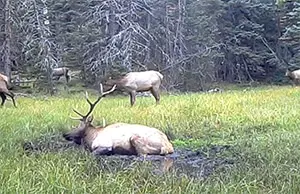 MUDDIED UP WALLOW –
You can tell when a wallow has been freshly worked. The water will be all stirred up. The area around the wallow will have fresh mud thrown and water still on the plants and grass. Bulls love to hit these wallows on the way to their bed and during the day while his cows are bedded. He might just hit it again once they are on the move to feed. If you find a wallow anywhere near a bedding area, this is a great location for a Static mid-day set-up. Add some splashing of the water to your raking and calling, and you can paint an extremely realistic picture that any bull within earshot will have a hard time ignoring.
If you choose to do this during the mid-day, be willing to work it until your evening hunt. Bulls will hit wallows at all times of the day as I said up above, it can be time well spent rather than being back at camp. If you get hungry, eat. If you get tired, sleep. But make sure your bow is ready to be picked up and shot. You just might be awaken by the sound of splashing water!
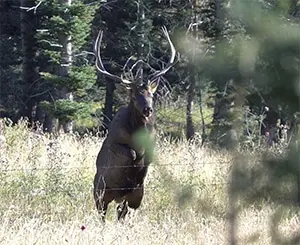 TO PULL FROM ANOTHER AREA –
It never fails that you will find yourself on the wrong side of the fence with elk screaming on the other side. It is either another hunt unit that you are not licensed for or maybe private property. In those situations, you can still move 400 yards or so away from the fence-line and put on your own party to pull elk to you. You might not pull the herd bull, but if you are hearing multiple bugles, that means there is a hot cow in the area and all of that rut activity is a calling card for every bull in the area. The good news is, you know there are other bulls in the area. You are hearing them. All you have to do is create an alternative opportunity for some of those bulls to go to. Maybe they have already been whipped by that big boss over there and they might be interested in some lower hanging fruit. Well, that is a golden opportunity for you to again select the playing field and create your own RutFest! This can be done solo, but it sure is a whole lot of fun to do with a partner or multiple partners.
RULE #3 –
No matter what, the most important thing is to establish shooting lanes and get in front of any cover for a backdrop to break up your outline. You must be aggressive in doing this. Expect that there will not be a perfect situation in this scenario. If it means standing in front of a tree as a backdrop, get there asap. If it means dropping to your knees to get cover behind you and to open up lanes, do it. Do what it takes to get the best opportunity for a shot. But just do it!
It is human nature to freeze not wanting to spook the bull. But why?
Is it because you think you will get an opportunity to move in once he passes you? You won’t. Once he hits your scent line, he’s gone!
Is it so that you can call him in again another time? The odds of calling in this bull if he busts you making a move, is the same as your chance to call him in once he hits your scent line while walking away. It may happen, but most likely not.
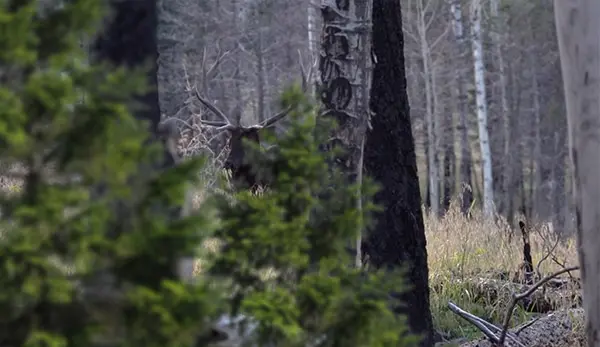 So when it comes to making an aggressive move, let’s do the math:
SITUATION: A bull is 50 yards out moving to your left. He has not seen you, but there is a tree directly in front of you blocking any shot opportunity.
FIRST ACTION: You freeze so you don’t spook the bull.
RESULT: The bull walks off. Most likely hits your scent line. Blown opportunity. So basically 0% chance of killing the bull.
SECOND ACTION: Watching to make sure the elk is moving, you move forward and to the right to get a shooting lane.
RESULT: The bull does one of the following:
Busts you and turns and canters away….Same result as the first action.
OR
He keeps on coming into your shooting lane, you cow call to stop him and… DEAD BULL!
I don’t know about you, but I definitely like my odds better with the Second Choice. By making a move you at least give yourself the chance at an opportunity. By staying put, you insure failure. And that y’all… is not an option!
RULE #4 –
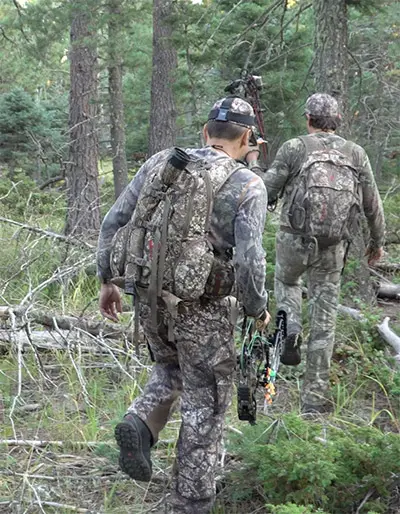
One of the biggest mistakes new elk hunters make is they hunt like they are hunting deer. Slow, methodical and not wanting to make a sound when moving through the woods. Okay, here it is… FORGET ABOUT ALL OF THAT! Are there times that you may need to move silently into a position or when you are stalking an elk? Yes, absolutely. But that is going to be 3% of the time. The rest of the time you are moving and not worrying about your noise. Especially if you are calling while you are moving.
Elk make noise. They expect other elk to make noise. Your feet hitting the ground. Branches snapping. Rocks rolling. Those are all “natural” sounds that elk expect to hear from other elk. When you are setting up and there are branches in your shooting lane or could impede your draw or debris around your feet that could make noise once a bull is in tight, move it all or break them off. Those noises before you begin calling actually sell the scenario.
Want a Pro Solo Hunter Tip? If you are making loud audible noises when you are moving up to get closer on a bull coming in, throw some cow calls through your grunt tube behind you, away from the bull, to set the scene of a cow making the noise, but further back from your location.