




You almost have to pinch yourself! You have been prepping, working and dreaming of this for almost a year and not 300 to 400 yards off….you’ve just gotten exactly what you’ve been dreaming of….. A BULL BUGLE!
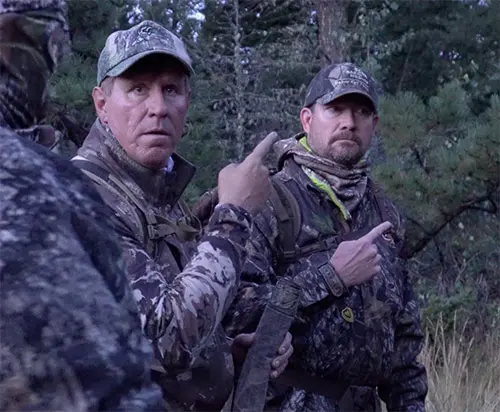 Yep, that’s a bull all right, but what now? Do I set up and start calling ? Where do I set up? What should my partner do? Do I bugle back? If so, what kind of bugle do I use? Do I cow call? Do we get after it and go straight to it or do we wait and listen to see what he does?
So many things to think about in the moment and you know that you only get so many opportunities. This is the exact moment that’s gonna make all the difference in having an opportunity or talking about the one that got away. You got the response…now what?
Even though there is no surefire answer for what you should do in all of the possible scenarios, there is a thought process you can go through to get you from that initial contact, an audible response, to putting yourself in the best position for an encounter.
This is all about Communication. Your Team Plan refers to roles, techniques, tactics, positions, do’s & don’ts and other things that need to be talked about, discussed and understood between those involved prior to ever hitting the field to insure that everyone is on the same page. This prevents waisted time as well as any bad feelings when it is understood and agreed to by all team members. This helps everyone to have a synchronized and coordinated response thus making the interaction that much more efficient,
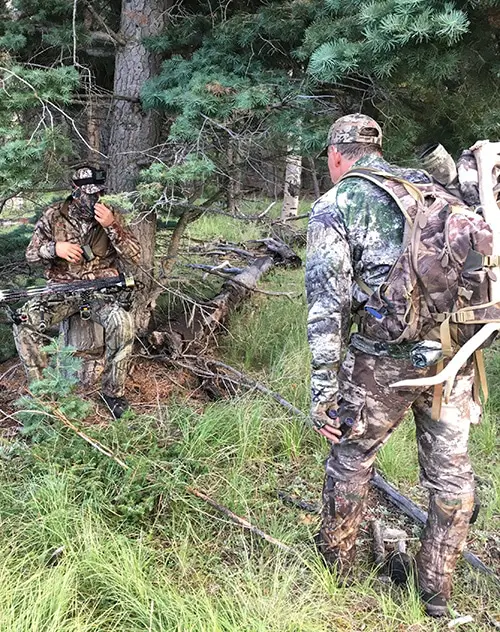 Here are just a few things that we suggest to be communicated:
Shooters & Callers
- When hunting partnered up or in groups, knowing your roles for each encounter, who is up as the shooter and who is the caller and what that looks like can save any hard feelings as well as give each person buy-in to everyone’s successes. How you do this is really up to how it works for the group. Are there multiple shooters for each encounter? One shooter and multiple callers? If one shooter, do you rotate for each encounter or by morning & evening hunt? How is the line-up figured?
General set-up placement and tactics
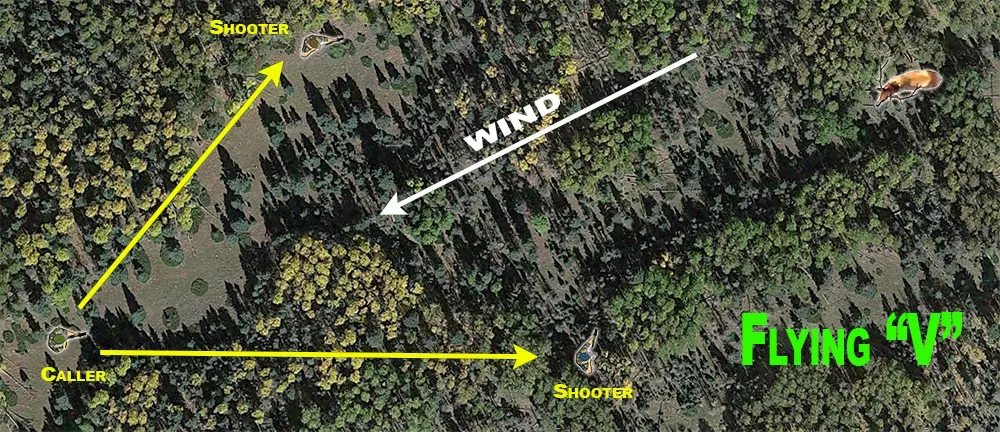
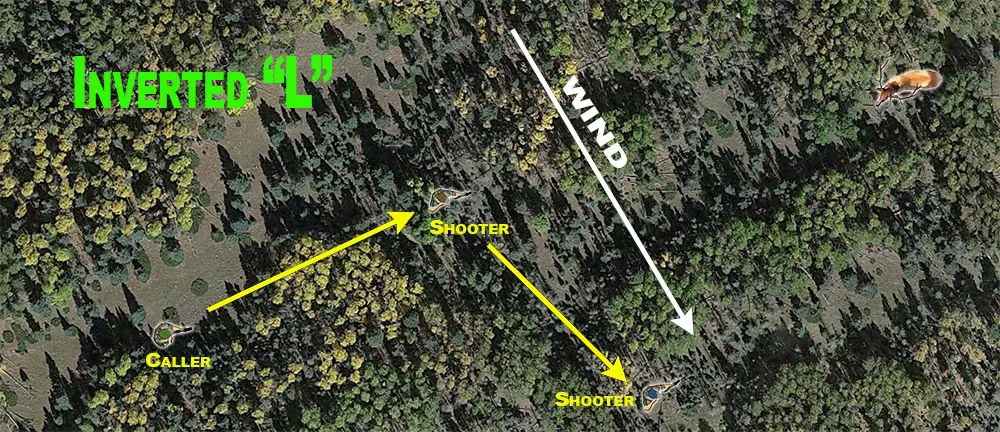
- Depending on your numbers, shooters vs callers, you should have a designated strategy or pattern when approaching, stalking, or setting-up on a bull. What does that look like? For example, for our caller and two shooter set-up strategy we have hand signals as to whether we will be in a flying “V” or in an inverted ‘L” pattern. everyone knows their side and their role. Critical when it gets hot!
Hand Signals
Visual signals that you can see and understand from a distance in order to communicate both when you are moving through the woods, or when you are in a setup, can make or break a situation. But it’s important to remember that for the shooter, or for the caller if the elk is in close proximity, keep signals close to the body and slow in motion to help avoid detection. Don’t start flailing your hands around with big movements that would get seen and bring an elk to a stop or spook them off.
Here are some videos with examples of possible visual signals:
Playlist
3 Videos

4:25
1:57
3:35
Was his response immediate or delayed?…
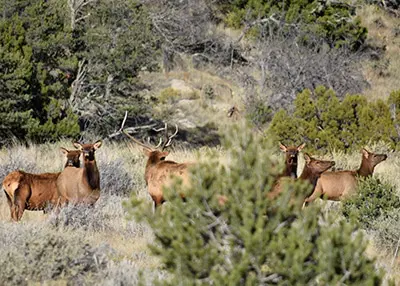
- Immediate – If he responded to a cow call, this bull is interested in “Cowing up” and may already be heading your way. Proceed with caution. DO NOT respond to his bugle with an immediate cow call. If you do, he controls the situation and will expect you to come to him. He does not know if you are alone or with another bull. By waiting and making him respond to you, you control the situation and you can still introduce bulls sounds as before, some raking (Raking is the cheapest MOST EFFECTIVE call you can find) at first and again, see how he responds. I know it sounds ironic, but raking is not an aggressive challenge. It is like a turkey fanning. It is a display. However it can totally initiate an aggressive response. When it does that, you are in high cotton!
- If he responded to a bugle, you have a bull interested in who you are…at the least just to advertise that he is in the area and is either your competition or your pal. After I cut the distance, I would try a soft cow call to test his reaction before giving another location bugle. Again, test his temperament. If he does respond to the cow call, follow the scenario above. If he only responds to a bugle, again use his response to move in closer. Once in to where he can hear it, go to the raking. Rake for about 1 to 2 minutes and wait…watching and ready. After 10 minutes, try again…add some low bull growls and groans. Go off of his response if there is one. Match how he responds…if he chuckles, you chuckle. If he screams at you, CUT HIM OFF!
- Delayed – If you get a delayed bugle , or chuckle, it will most likely be from a distance. Was he responding to you or another bugle further away that you can’t hear? It may also be because he is passive. Cutting the distance is the most important strategy here. Cut it in half and try for another response. If you get one, work it like we have already covered. Remember, you DO NOT escalate the emotion unless he does.
- Immediate – If he responded to a cow call, this bull is interested in “Cowing up” and may already be heading your way. Proceed with caution. DO NOT respond to his bugle with an immediate cow call. If you do, he controls the situation and will expect you to come to him. He does not know if you are alone or with another bull. By waiting and making him respond to you, you control the situation and you can still introduce bulls sounds as before, some raking (Raking is the cheapest MOST EFFECTIVE call you can find) at first and again, see how he responds. I know it sounds ironic, but raking is not an aggressive challenge. It is like a turkey fanning. It is a display. However it can totally initiate an aggressive response. When it does that, you are in high cotton!
What Emotion was in his response?
Very simply, is he being a LOVER or a FIGHTER?
Was his response Aggressive or Passive? Advertising?Irritated? Challenging? Just saying “I’m here”. And I throw the buddies, or bulls just wanting to hang out with other bulls, into the LOVER category because it is a passive mode that will soon be changing with the onset of higher testosterone levels.
We talk about some of these above in this piece. But for clarity, understand that a bull’s emotion is displayed through his volume, intensity, length and rasp. Just like when your mom use to call your name as a kid. If mom was just calling your name, you answered and said “I’m right here mom”. But if mom added that volume and anger to her voice, you were either going to run to her with worry or, as in my first option…run away! FAST! Lol.
This is critical to understand, because you do not want to answer a passive bull with anger. You will run that bull off. You have to use passive calls and work his “herd” instincts. Get up his curiosity to see what this other elk is. But at the same time, if you are getting an aggressive response, this is possibly a bull that you can lather up and slowly raise his temperature until he just cant take it any more and comes in with fire in the eyes.
But I want to add here, when in doubt as to how to handle a bull, be a lover, friend or pal over a fighter. You attract more flies with sugar than the thought of a possible butt whooping. It also give you the opportunity to take it to an aggressive state if needed.
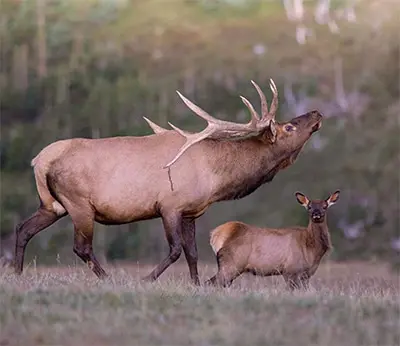
Classifying the different kinds of responses as aggressive, passive:
-
-
- – Location Bugle – passive
- – Bow Call (Bull Mew) – passive
- – Advertising Bugle, bull sounds – passive
- – Chuckle – passive
- – Challenge Bugle – aggressive
- – Lip Bawl Bugle – aggressive in two ways. This is a display bugle to show dominance to either cows or to other bulls. For cows, this is to show them that he is the best option for breeding. For the bulls, it is a warning that they don’t want any of this. A lip bawl can be shorter when aimed at cows and longer and more intense when aimed at another bull.
- – Frustrated Irritated grunts and groans – Depending on situation, this can be aggressive, a warning, but often related as breeding noises.
- – Round Up bugle – Round Up bugle – Can be used aggressively to other bulls or toward their own cows. But can be also be used to urge or invite another bull’s cows to “come on over”. The latter can really tick off a herd bull.
- Raking – This is an interesting one. Depending on the time of year, it has different modes. It can simply be a bull feeling his oats, or prepping for the upcoming rut or an act of displaying dominance to cows or other bulls. The last one can elicit an aggressive act for sure. That’s why during the early season, raking will bring in bulls that want to “check out” or “size up” the competition. And even during the rut, when one bull hears another bull raking that also has cows, he knows it’s a bull showing off to a lady, but their isn’t enough information to know what the competition looks or really sounds like. So, in that way, it’s not as intimidating and can raise the curiosity of another bull without scaring him off. I believe that raking is the often the cheapest and most effective call on the market!
-
3rd – Evaluating the situational aspects
Wind and Thermals
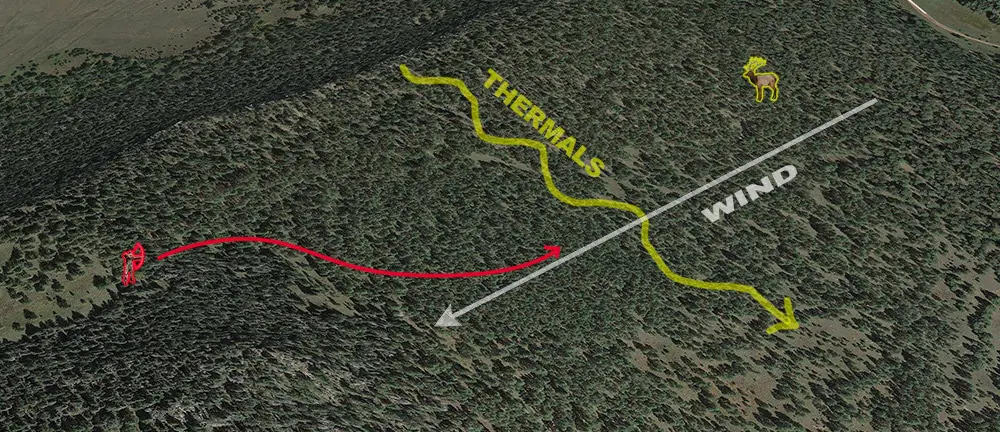
- Again…nothing else matters if you don’t have these in your favor. You should be moving immediately to either back out and circle or circle immediately. The wind doesn’t have to be in your face, but at least a crosswind and moving on the downside or same level as the thermal.
How far away was the response?
- Close (100 to 200 yards) – If this has happened, you can forget about the first response, we are looking for a set-up at this point and once in place we will re-evaluate after we get another response. Once set-up, you are ready to introduce calls and again, I work near to far. I am going to have my grunt tube under my arm aiming behind me to throw the call further back and start with a light cow call. I will stay with this for a few minutes and really looking to see if he is coming in silently. From there will go to whatever got the response in the first place, still behind me. If I don’t get a response at all after 5 minutes, then I am in search mode again with my calls to elicit a response; light Location bugle…to a louder location bugle…to a double bugle.
- Farther (300 to 400) – I am closing the gap here as close as the terrain and cover and any additional responses allow. Making sure to be observant as well as listening for other possible animals. Be prepared to “Hurry Up and Slow Down”.
- Far – My first response is to close hard and fast. I am listening for additional responses to be able to tell if they are getting closer or farther. I want to get to that 200 yard range observing the area terrain and cover. Once there, if I have not heard any follow-up calls in a while, I am going with the light cow call again behind me. And then go from there.